One interface. Every AI provider.
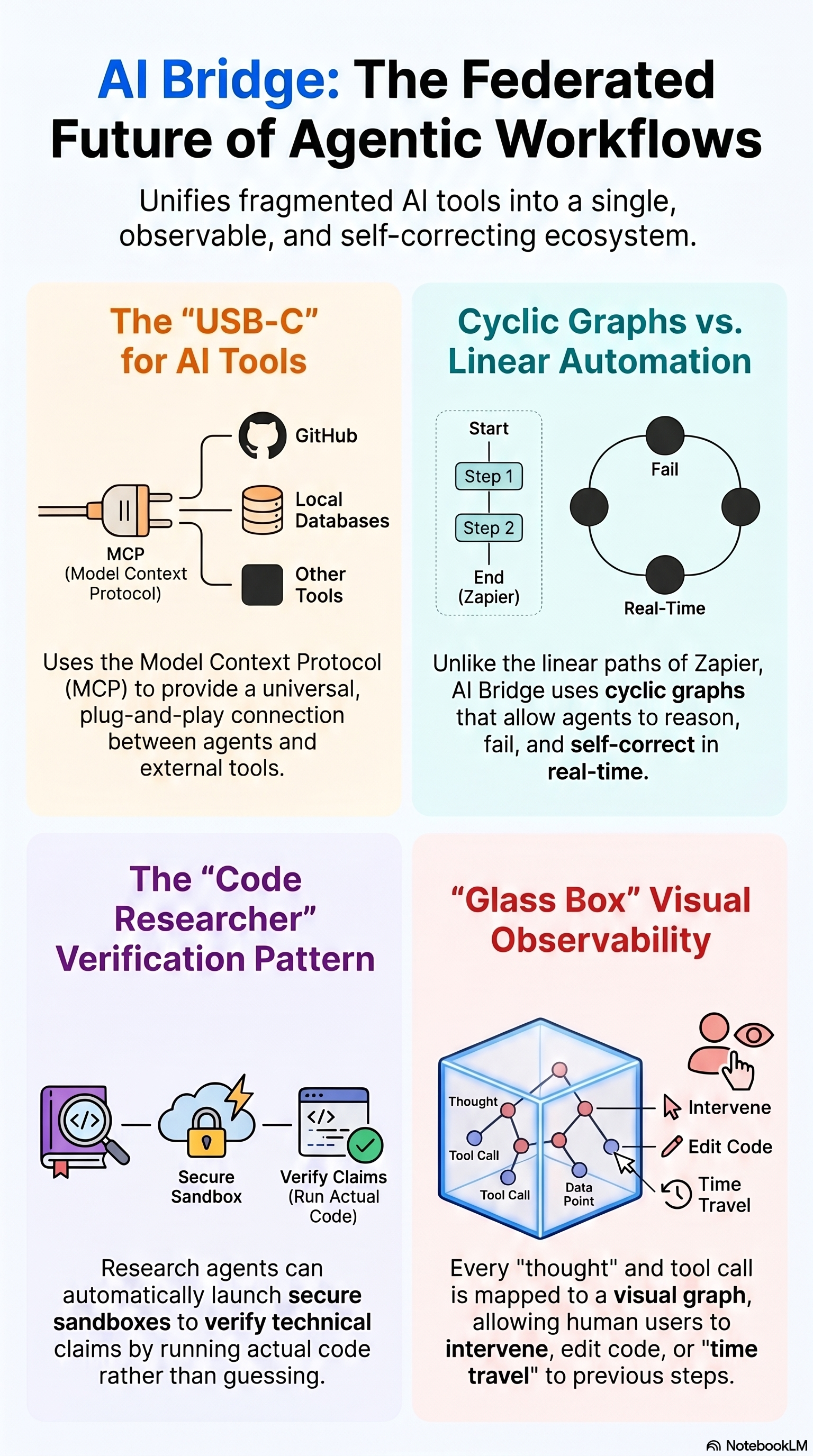
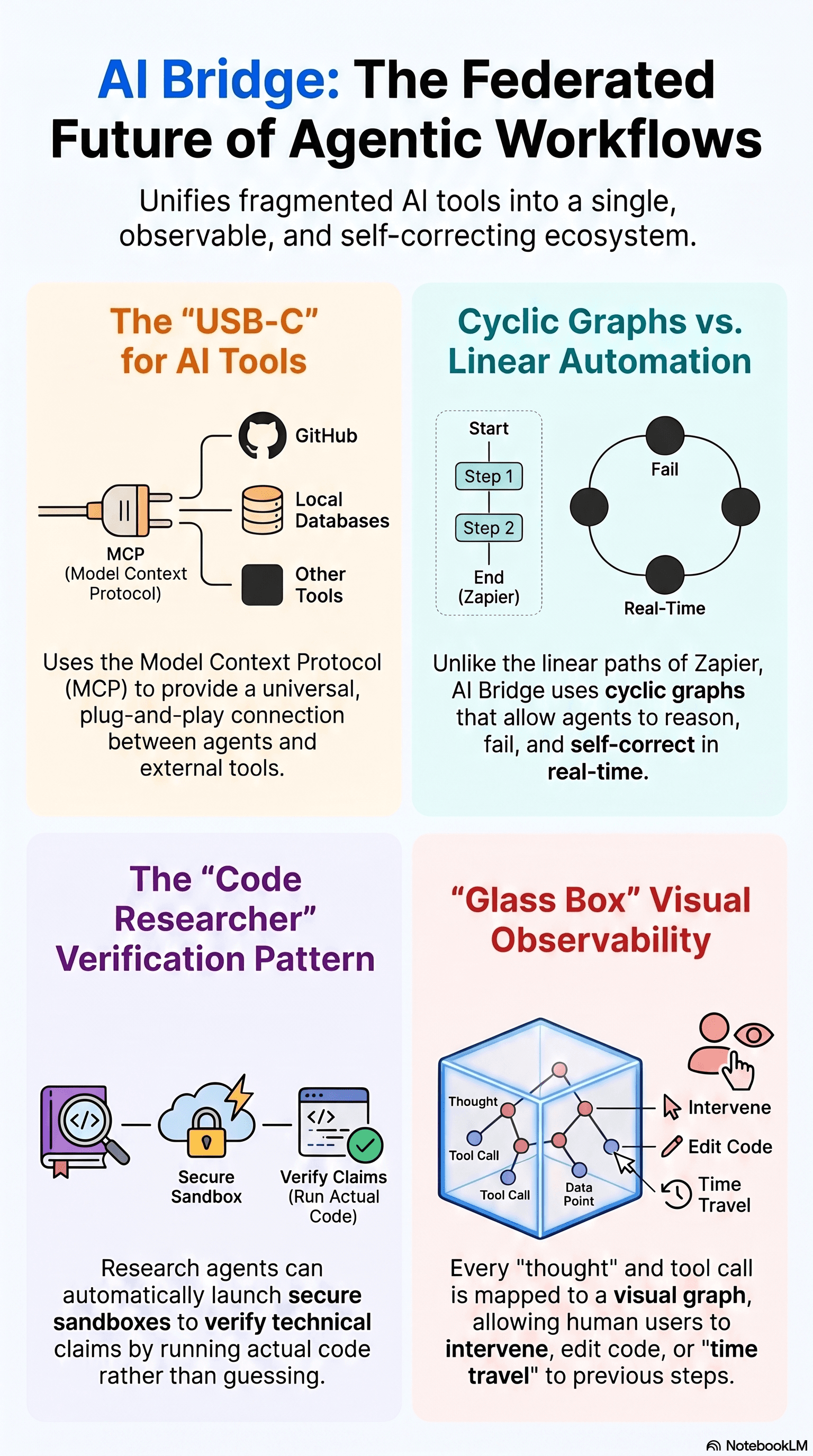
AI Bridge v2 is a production-ready orchestration platform that chains Perplexity, Claude, OpenAI, Grok, Groq, and Abacus into sequential or parallel workflows — with AES-256 API key encryption, full conversation persistence, and per-model cost tracking built in.
Chain any provider. Run it now.
Add your API keys in the settings panel, build a workflow, and execute — calls go direct from your browser to each provider.
Calls go direct browser → provider. Keys stay in memory only — never sent to Conqueror Studios servers.
The multi-provider tax
Every serious AI team ends up writing the same boilerplate: provider-specific clients, brittle retry logic, manual cost tracking, and no way to chain models without glue code that breaks at every API update.
- Provider-specific SDKs
Anthropic, OpenAI, Perplexity, and xAI all have different auth headers, message formats, and error shapes.
- No workflow chaining
Running a Perplexity research step followed by a Claude spec step followed by a GPT roadmap review requires custom orchestration code every time.
- Secrets sprawl
API keys in environment files, hardcoded strings, and .env leaks — no central encrypted store.
- Zero cost visibility
Token counts and dollar costs are buried in provider dashboards with no cross-provider aggregation.
What AI Bridge ships with.
Every capability grounded in the v2.1.0 codebase — not a roadmap.
LangChain unified wrapper
A single LangChainWrapper class normalises ChatAnthropic, ChatOpenAI, and ChatGroq behind one .complete(model, messages) interface — swap providers without touching workflow logic.
AES-256 key management
API keys are stored Fernet-encrypted in Postgres. Keys are decrypted per-request in memory and never written to logs or responses.
Sequential & parallel execution
Chain providers in order — Perplexity researches, Claude specs, GPT reviews — or fan out to all providers simultaneously and aggregate. Configurable per workflow.
Real-time cost tracking
Per-provider, per-model cost rates (2025 pricing) are calculated on every call. The analytics service aggregates token counts and dollar spend by provider, model, and date range.
Conversation persistence
Full chat history stored via SQLAlchemy async ORM. Every message — role, content, token counts, cost — is persisted with conversation grouping for replay and audit.
Retry with backoff
Configurable retry attempts with exponential backoff on provider errors. Failed calls are retried transparently — the workflow never surfaces a transient 429 or 5xx.
Build workflows in the UI, not config files.
The React MultiAIPlatform component makes direct browser-to-provider API calls with your own keys — no server round-trip for the UI layer. The FastAPI backend handles persistence, analytics, and encrypted key storage when you need the full stack.
- Step builder— Add providers, pick models, write per-step instructions, toggle whether the step feeds on the previous output.
- Execution modes— Switch between sequential (chain outputs) and parallel (fan-out to all providers) per run.
- Workflow persistence— Named workflows save to localStorage and reload across sessions — no backend required for the UI.
- Export results— Download the full run as Markdown or JSON with one click.
Production backend out of the box.
The backend is structured around a clean services pattern: each concern (conversation persistence, analytics, provider routing) lives in its own module with no cross-cutting imports. Swap Postgres for another async SQLAlchemy target without touching business logic.
- Client factory— get_client() resolves the right provider client from the encrypted key store in one call.
- Async ORM— SQLAlchemy async with PgBouncer transaction pooling — no blocking DB calls in the request path.
- Usage analytics— The analytics service groups token and cost data by provider, model, and date — queryable via a single endpoint.
- Microservices-ready— Auth, workflow engine, provider bridge, analytics, and webhook delivery are designed as separable services.
Every model. Every integration type.
Pricing sourced from live 2025 API rates, baked into the cost calculator.
| Provider | Models | Integration | Input $/M | Output $/M |
|---|---|---|---|---|
| Perplexity | sonar-pro, sonar, sonar-reasoning-pro | Direct + LangChain | $2.50–5.00 | $10.00–20.00 |
| Claude | claude-opus-4, claude-haiku | LangChain (ChatAnthropic) | $0.25–15.00 | $1.25–75.00 |
| OpenAI | gpt-4o, gpt-5, gpt-4o-mini | Direct + LangChain | $0.15–5.00 | $0.60–15.00 |
| Grok | grok-2, grok-1.5 | OpenAI-compat (xAI base URL) | $3.00–5.00 | $10.00–15.00 |
| Groq | llama3-70b-8192 | LangChain (ChatGroq) | $0.05 | $0.10 |
| Abacus AI | research, code, data-analyst | Direct API | $3.00 | $10.00 |
What's next for AI Bridge.
- DB query optimisation + Redis caching
- MFA (TOTP + WebAuthn)
- OpenTelemetry + Prometheus monitoring
- Rate limiting per user + provider
- Full microservices split
- Event streaming (Kafka/Redis Streams)
- 80%+ test coverage
- CI/CD pipeline with E2E gating
- Kubernetes + Helm + Istio mesh
- Multi-region GeoDNS failover
- Advanced AI orchestration (MCP/A2A)
- Agent marketplace integrations
Stop writing provider glue. Start shipping workflows.
We're onboarding design partners who need multi-provider orchestration in production. Bring your use case.